 Skip to content


On 24 September 2026, Google shipped a change to Demand Gen campaigns that most South African advertisers have not adjusted for yet: image ads on YouTube Shorts and in Gmail can now send someone to your landing page with a single tap.
Previously those placements needed an extra interaction before a visit. Removing that step sounds minor. It is not. It moves a browsing surface much closer to a direct-response channel, and it rewards advertisers who have the right creative format ready before their competitors do.
Here is what actually changed, what it demands of your creative and landing pages, and how to judge whether it is working.
Key takeaways
| What changed | What to do about it |
|---|---|
| One-tap visits from Shorts | Only works on 9:16 full-bleed image ads. If you have not uploaded that format, you do not get the feature. |
| One-tap visits from Gmail | Simplifies a placement that already performs. Worth adding Gmail if you excluded it previously. |
| Promoted pins in Google Maps | Affiliate location extensions, aimed at retail networks and dealerships with physical branches. |
| AI product questions on YouTube | Viewers can ask about products without leaving the video. Relevant if you run a product feed. |
| Faster traffic, same landing pages | A shorter path to your site exposes a weak destination faster. Fix the page before raising budget. |
| Display is migrating here | Google began moving Display campaigns into Demand Gen from June 2026. Plan the transition rather than waiting to be moved. |
Quick answers
What changed in Demand Gen campaigns in September 2026?
Google added one-click experiences on image ads in YouTube Shorts and Gmail, letting a viewer reach your landing page in a single tap. It also added affiliate location extensions as promoted pins in Google Maps, and AI-assisted product questions alongside YouTube product feeds.
What creative format do I need for one-tap Shorts ads?
9:16 full-bleed image ads. Google has been explicit that the one-click experience applies when you upload that format. A cropped 16:9 asset will not qualify.
Is Demand Gen a direct response channel now?
Closer than it was, but no. These are still browsing surfaces where people are not searching for you. One-tap shortens the path to a visit. It does not create the intent that a search query already contains.
What Google actually changed in Demand Gen campaigns
The update to Demand Gen campaigns came as part of what Google called its September Demand Gen Drop. Three things matter for South African advertisers.
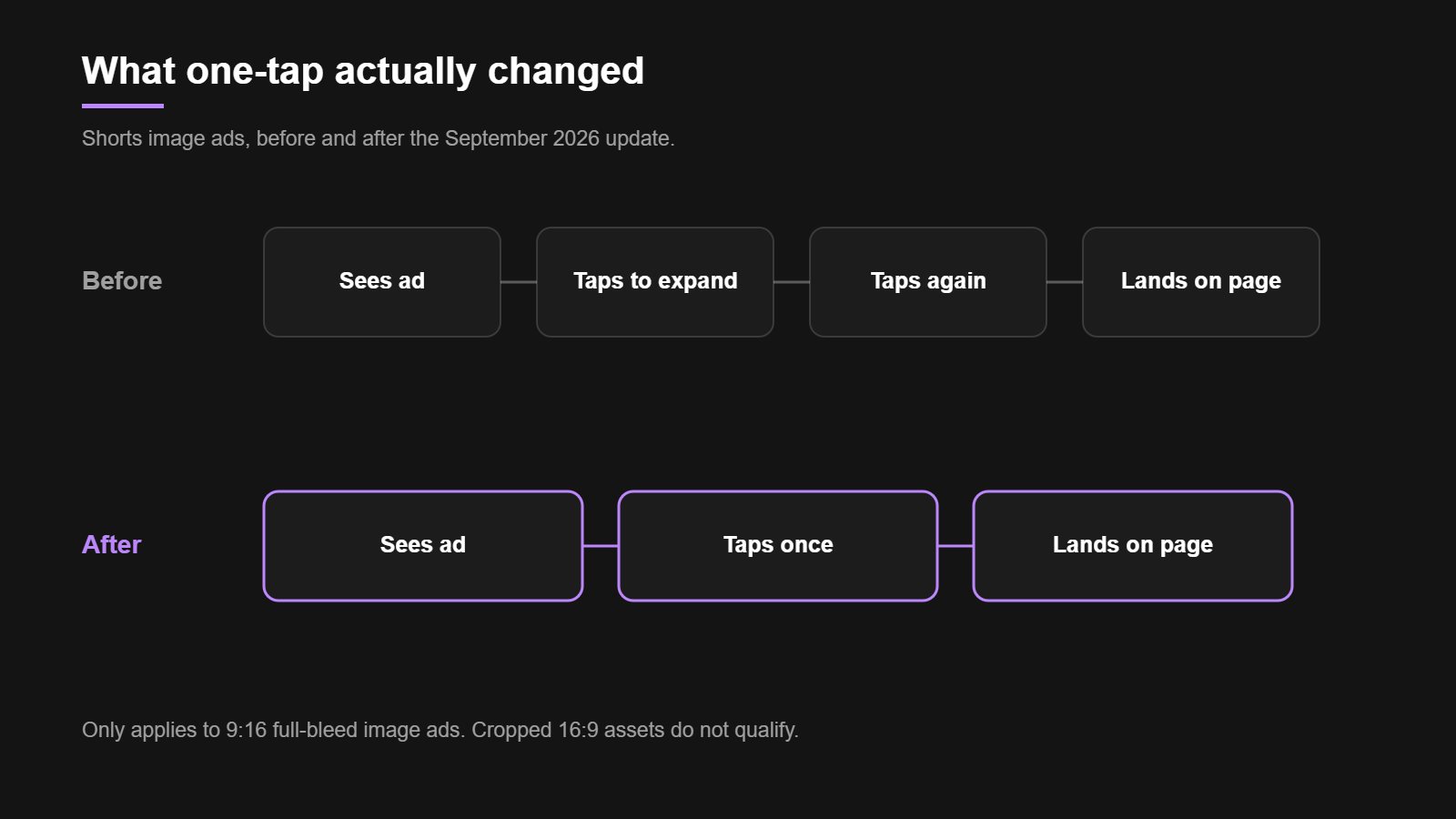
One-click experiences. In Google’s own words, consumers can now visit your landing page with a single tap on image ads in YouTube Shorts and Gmail. On Shorts this applies to 9:16 full-bleed image ads specifically.
Gmail performance. Google states that advertisers adding Gmail to their Demand Gen campaigns see image creatives achieve, on average, a 40% increase in conversions at the same ROI. Treat that figure with the caution any platform’s own performance claim deserves, but it is a strong enough signal to justify testing the placement if you have been excluding it.
Affiliate location extensions. Retail networks and dealerships can now promote physical locations through pins across Google Maps, displayed while people browse, search and navigate. For South African businesses with branch networks, this is the sleeper item in the announcement.
The full detail sits on Google’s own announcement.
The honest framing on Demand Gen campaigns that most coverage will skip
Every agency blog this week will tell you one-tap changes everything. It does not.
Demand Gen campaigns serve on surfaces where people browse rather than search, and that has not changed.
People are browsing, watching and reading email. They are not typing a problem into a search box. Removing a tap makes it easier for an interested person to arrive, which is genuinely useful, but it does not manufacture intent that was never there.
The practical consequence is uncomfortable. A shorter path to your site means more visitors arriving faster, with less consideration behind each visit. If your landing page is weak, this change will make that visible sooner and more expensively. Traffic arriving in one tap converts worse than traffic that worked to get there, unless the page does the qualifying instead.
So the correct sequence is: fix the destination, then turn on the faster route. Not the other way round.
What this demands of your creative
The feature is format-gated. That is the part worth acting on immediately.
- Upload 9:16 full-bleed images. Without them, Shorts one-tap does not apply to your ads. This is the single highest-priority change in the whole announcement.
- Stop cropping one asset into every placement. A Shorts frame and a Gmail creative do different jobs at different sizes. Cropping a 16:9 asset produces awkward or invisible Shorts placements.
- Lead with the product, problem or benefit. On a browsing surface you have a second or two, and no search query has pre-sold anything.
- Keep on-screen text legible at phone size and add captions for sound-off viewing.
- Make the call to action visually distinct. If the frame carries four messages, the viewer works out none of them.
Google’s specifications are worth having to hand: images at 1.91:1, 1:1 and 4:5 or 9:16, up to 5MB each. Headlines run to 40 characters with at least one at 30 or fewer, descriptions to 90, business name to 25.
Gmail deserves a second look
Plenty of South African advertisers switched Gmail off after a disappointing test. Two things have changed since.
The one-tap update removes friction from the placement. And it is worth understanding how Gmail bills: the charge is on the teaser click, the first click that expands the ad. You are not charged again for the secondary click through to your website. That billing structure is why Gmail metrics often read oddly next to other placements, and why comparing them on identical terms misleads you.
Review Gmail separately from Shorts, on its own numbers, rather than as part of a blended campaign average.
Make the landing page deserve the tap
Send each ad to the page matching its offer, never automatically to your homepage. When the ad promise, page headline and page content agree, the visitor confirms they are in the right place without hunting.
Our landing page design for ads and campaigns builds each page around one offer, one audience and one action, which is the structure this kind of traffic needs.
Four checks before you spend:
- Test the full path on a phone, not the page’s appearance on a desktop. Tap through the ad exactly as a customer would.
- Check load speed on mobile data, not office fibre. A one-tap ad that lands on a slow page wastes the advantage entirely.
- Remove fields, redirects and pop-ups that interrupt the action.
- Put the primary action near the top, with supporting detail below for people who need it.
If an audit shows the page is the constraint, fix that before increasing spend. More budget does not repair a destination problem, it just buys more evidence of one.
Measure visit quality, not taps
One-tap will make your click numbers look better. That is almost guaranteed and almost meaningless on its own.
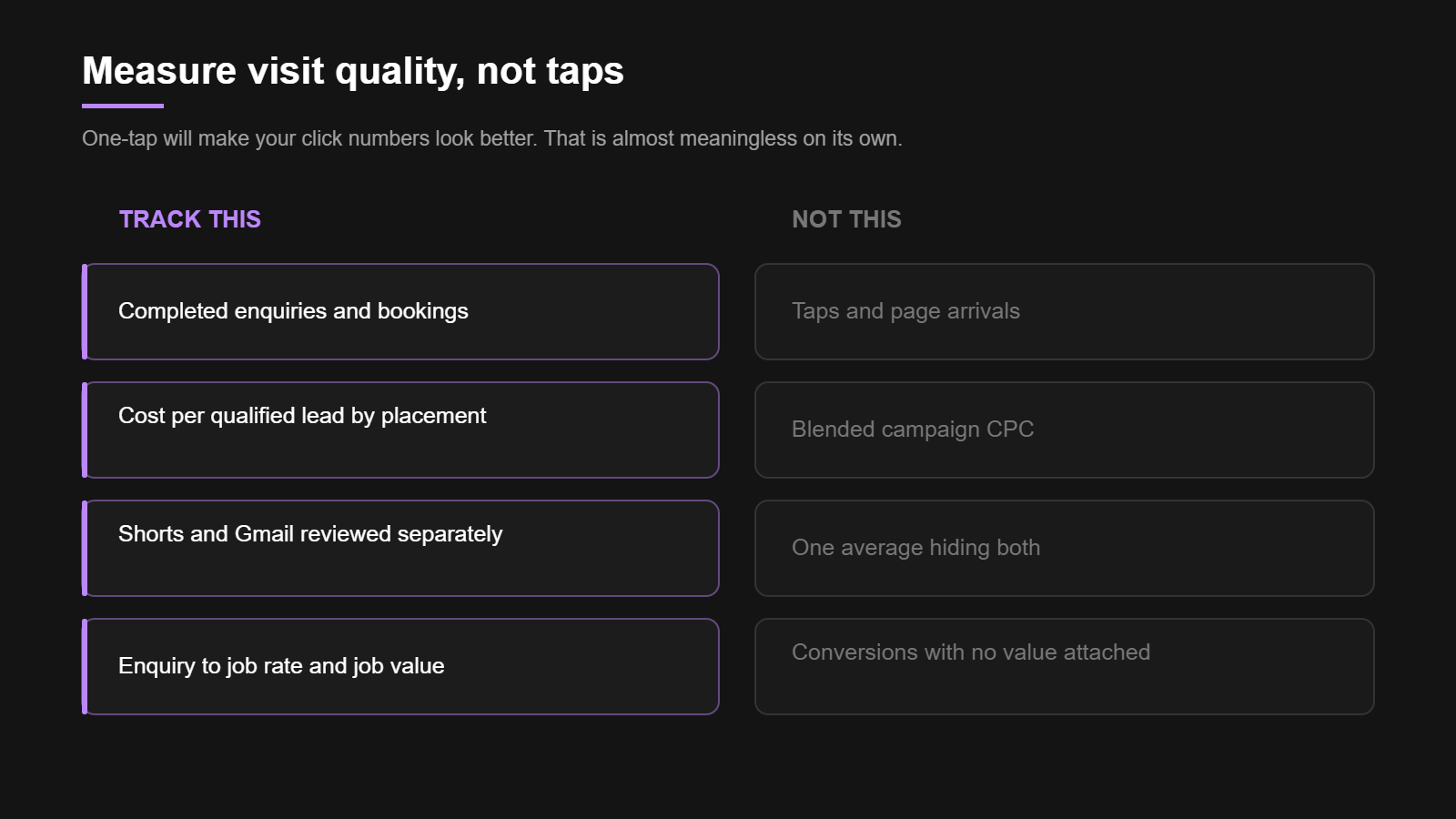
Verify that conversion tracking fires on the final confirmation event, not on a page arrival. Then allow for the campaign’s conversion cycle before reacting to early numbers. A strong result on one placement regularly hides a weak one on another.
If you want to sanity-check whether the maths works at your job value before committing budget, our Ads Break-Even Calculator does that in a couple of minutes.
Changing Demand Gen campaigns one variable at a time
Adopting a new format is itself a change. Do not pair it with a new audience, a new offer and a new destination in the same week, then wonder what moved the result.
- Change one major variable at a time: creative, audience or destination.
- Set a review window before you start, and hold to it rather than reacting to three days of data.
- Keep a short change log with date, adjustment and intended result.
- When taps rise but conversions do not, check mobile speed, message match and tracking before adding budget.
What management costs
Our Google Ads plans, all excluding ad spend. Your budget goes directly to Google and we take none of it.
| Plan | Monthly | What it covers |
|---|---|---|
| Basic | R3,500 | 1 campaign, 10 to 12 core keywords, up to 4 ad variations, conversion tracking setup, monthly report. Manages ad budget up to R5,000. |
| Standard | R7,500 | Up to 3 campaigns, 20+ keywords and negatives, 6 to 8 ad variations, A/B testing, detailed monthly report. Manages ad budget up to R10,000. |
| Premium | R15,000 | Up to 5 campaigns, 50+ keywords and long-tail, 10+ ads and extensions, remarketing and CRO input, competitor notes. Manages ad budget up to R20,000. |
Full detail on our Google Ads management page.
Frequently asked questions
What are Demand Gen campaigns?
Google’s visual, discovery-led campaign type. Ads serve across YouTube including Shorts, the Discover feed, Gmail, Maps and the Display Network. It replaced Discovery campaigns, absorbed Video Action Campaigns, and Display campaigns are now migrating into it.
Do I need new creative for the one-tap feature?
For Shorts, yes. The one-click experience applies to 9:16 full-bleed image ads, so if your account only holds cropped 16:9 assets you will not get the feature. That upload is the fastest win available from this update.
Should a small South African business use Demand Gen campaigns?
Only once Search is working and you have budget beyond it. Demand Gen campaigns interrupt people who are not looking for you, which costs more per enquiry than answering someone already searching. If your budget only covers one channel, put it on Search.
Can Demand Gen campaigns work for a local business with a small audience?
Yes, provided the creative makes the service area obvious and the offer matters locally. Then check that enquiries come from people you can actually serve, because a broad discovery surface will happily deliver leads from outside your radius.
How is Gmail billed in a Demand Gen campaign?
On the teaser click, meaning the first click that expands the ad. You are not charged for the secondary click through to your website. That is why Gmail metrics look different from other placements and should be reviewed separately.
How long before I can judge the results?
Set a review window before launching and wait for enough conversion activity to read a pattern, not a handful of visits. Early movement on a discovery channel is frequently noise.
What happens to my Display campaigns?
Google began a phased migration of Display into Demand Gen from June 2026, with a migration tool available to eligible advertisers. Eventually new campaigns can only be created within Demand Gen. Planning that transition deliberately beats being moved automatically.
Before you switch it on
The advertisers who benefit from this update are the ones whose landing pages were already ready. A faster route to a page that does not convert simply spends your budget more efficiently on the wrong outcome.
Request a free audit and we will tell you whether your destination can carry this traffic, or run the Ads Break-Even Calculator first to see whether the numbers work at your job value.
