 Skip to content


Almost every article written about declining organic traffic this year quotes the same number: organic click-through rates fell 61% once AI Overviews arrived. It was a real finding. It is also out of date, and the research team that published it has already said so.
That matters, because if you are making budget decisions off a 2025 headline, you are solving last year’s problem.
Here is what the data actually shows now, what your Search Console reports are really telling you, and how to work out whether you have a visibility problem, a click problem, or a conversion problem. They need completely different fixes and cost completely different amounts.
Key takeaways
| What to know | Why it changes your next move |
|---|---|
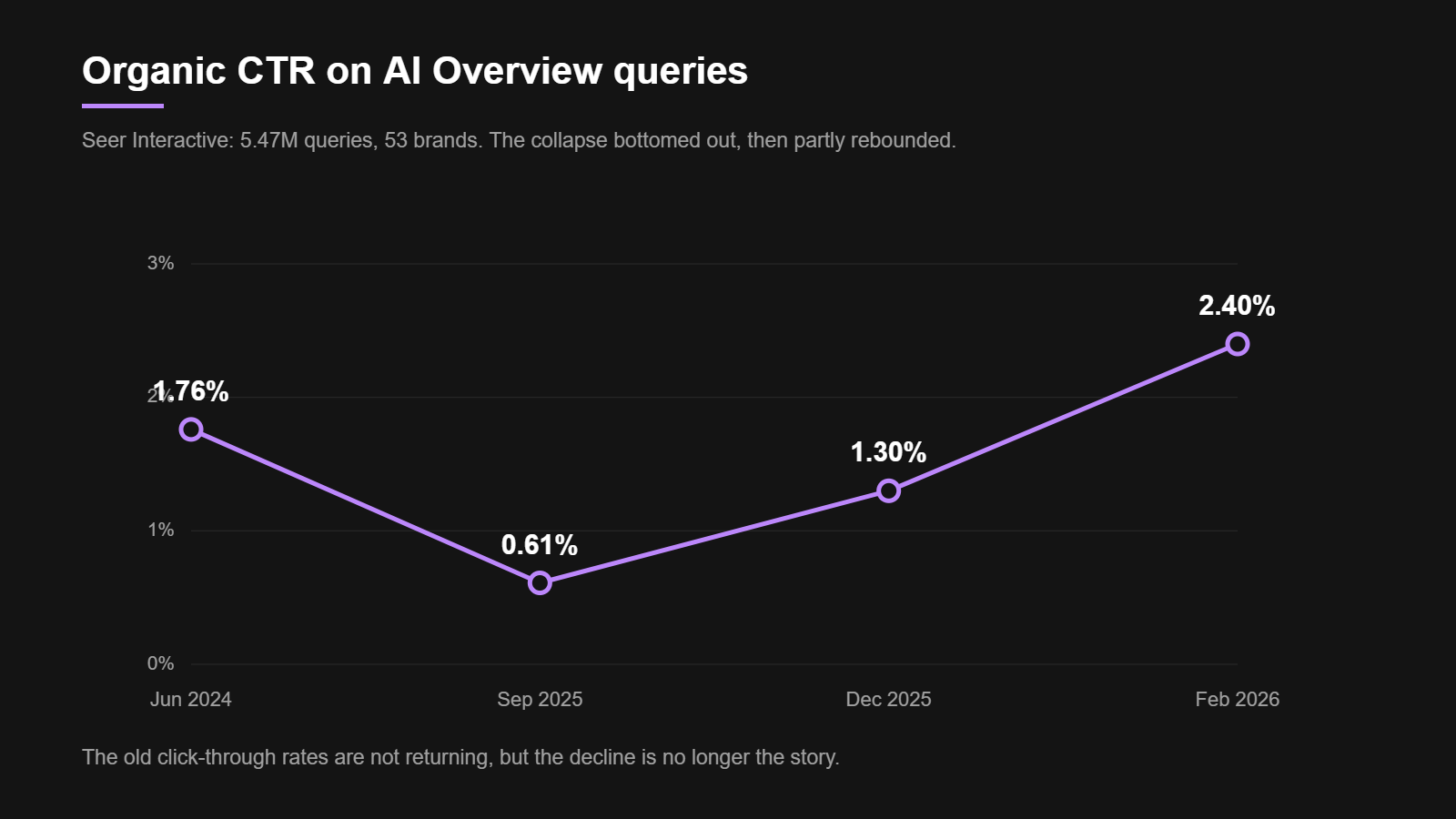
| The CTR collapse bottomed out | Organic CTR on AI Overview queries fell to 1.3% in December 2025, then climbed back to 2.4% by February 2026. The trend reversed. |
| The old rates are not returning | A partial rebound is not a recovery. Plan for structurally lower click volumes than 2023. |
| Citation is the new ranking | Being quoted inside an AI answer now matters more than sitting at position one beneath it. |
| Diagnose before you spend | Impressions down, clicks down and enquiries down are three different problems with three different price tags. |
| Fix patterns, not pages | If a template is leaking, fixing one page teaches you nothing and changes nothing. |
| Rebuilds are rarely the answer | Most declines are presentation or conversion problems, not architecture problems. |
Quick answers
Why is my organic traffic declining in 2026?
Declining organic traffic almost always comes down to one of three mechanisms: fewer queries qualify your page (impressions down), people see you but do not click (impressions flat, clicks down), or they click and do not enquire (clicks flat, conversions down). Search Console tells you which within about twenty minutes.
Did AI Overviews really cut click-through rates by 61%?
They did, and then the picture changed. Organic CTR on AI Overview queries dropped from 1.76% in June 2024 to 0.61% by September 2025, bottomed at 1.3% in December 2025, and recovered to 2.4% by February 2026. The collapse was real. Treating it as an ongoing free-fall in 2026 is not accurate.
Should I rebuild my website if traffic is falling?
Rarely. Rebuild only when the decline traces to template-level structure or a conversion path that fails across many pages. If impressions are stable and only clicks fell, you need titles, snippets and above-the-fold changes, not a new site.
1. The number everyone is quoting has already been revised
Seer Interactive’s September 2025 study is the source behind most of what you have read about declining organic traffic. It analysed 3,119 informational queries across 42 organisations and found organic CTR on AI Overview queries had fallen from 1.76% to 0.61%, a 61% drop. Paid CTR fell 68%.
Then they ran it again. Their 2026 update covers 5.47 million tracked queries across 53 brands and 2.43 billion organic impressions. It found something their own model had predicted would not happen: the decline reversed. Organic CTR on AI Overview queries climbed from a floor of 1.3% in December 2025 to 2.4% in February 2026.
Two honest readings of that, and you need both.
The optimistic one: the worst of the compression appears to be behind us, and the panic content published through 2025 described a trough rather than a trajectory.
The realistic one: 2.4% is still well below where informational queries sat before AI Overviews, and nothing suggests a return to 2023 levels. What has emerged is a new baseline where being cited inside the AI answer is the difference between visibility and invisibility.
Bain’s B2B work is the more uncomfortable read for anyone selling to businesses. It found B2B click-through rates falling by as much as 30% in some categories, and noted that 85% of B2B buyers purchase from their day-one list, meaning the vendors they already had in mind before searching at all. Less search visibility means less ability to get onto that list.
2. Declining organic traffic is not usually a ranking problem
“Did we lose rankings” is the wrong question, and it sends you down the wrong road. Rankings can be identical while traffic halves.
The useful question has three possible answers. Pull the Performance report, compare the last 28 days against the previous 28, and work out which one you are looking at.
What to pull, in one sitting:
- Performance report, last 28 days versus previous 28, then the last 3 months versus the previous 3. Short windows catch shocks, long windows catch drift.
- Queries tab, filtered to queries with meaningful impressions, sorted by click loss. Ignore the tail.
- Pages tab, looking specifically for high impressions with falling clicks. That combination is the most fixable problem you have.
- Grouped by template. If every service page or every location page moved together, you have a structural issue, not a content issue.
Twenty minutes of this beats a month of guessing.
3. The three mechanisms behind declining organic traffic
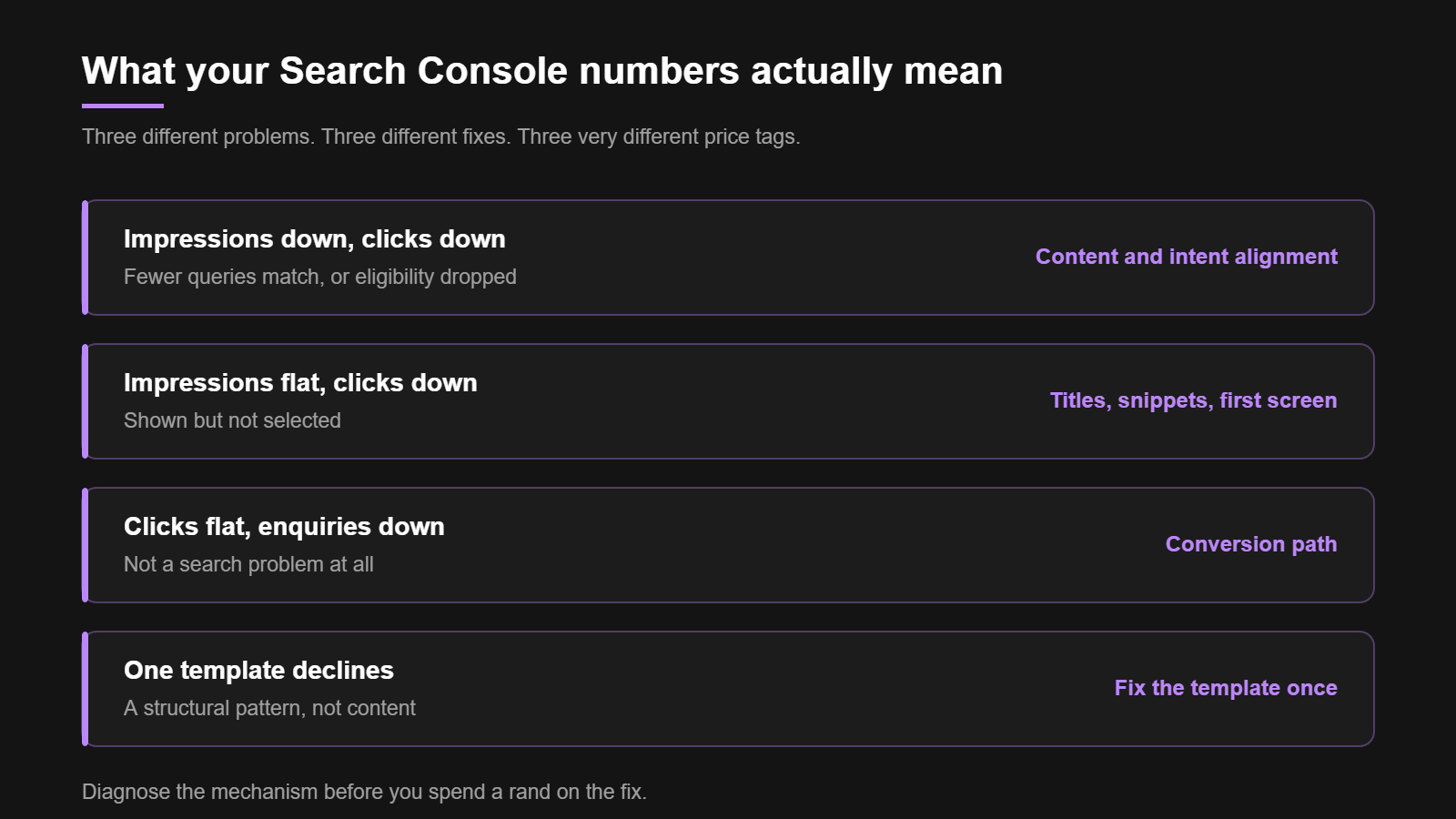
| What you see | What it means | The fix, and roughly what it costs |
|---|---|---|
| Impressions down, clicks down | Fewer queries match your page, or it is no longer consistently eligible to appear. | Content coverage and intent alignment, then technical checks. The slowest and most expensive of the three. |
| Impressions flat, clicks down | You are being shown and not selected. Usually snippet and title, sometimes an AI answer above you. | Titles, meta descriptions and the first screen of the page. Cheapest fix, fastest feedback. |
| Clicks flat, enquiries down | This is not a search problem at all. The page is getting traffic and losing people. | Conversion path work. Do not buy SEO for this. |
| One template declines | Structure, internal linking logic or a shared title pattern. | Fix the template once, roll it across every page using it. |
The third row is where most money gets wasted. Businesses buy SEO retainers to solve conversion problems, then conclude after six months that SEO does not work. The traffic was never the issue.
4. When clicks fall and impressions hold, fix the presentation
This is the most common form of declining organic traffic and the cheapest to address.
- Give the title a reason to click. Not the brand label, not the service name. The differentiator or the specific outcome.
- Make the first screen answer the query. If the result promised costs, show costs. A generic introduction trains people to leave.
- Put the next step above the fold on any page losing clicks. One action, not four.
- Keep the heading structure clean. It is what lets both search engines and AI assistants work out what the page is for.
Start with your highest-impression pages. They are already being shown, which means a presentation change can move numbers inside one reporting window. We cover the structural side of this on our SEO services page, and the technical layer on technical SEO.
5. Citation is the new ranking
For anyone dealing with declining organic traffic, the Seer data contains the most actionable finding of the lot, and it is not the headline number. Brands cited inside an AI Overview earn materially more clicks than brands ranking on the same query without a citation.
That reframes the whole exercise. The goal is no longer only to rank above competitors. It is to be the source the AI answer quotes.
What makes a page citable:
- Answer the question in the first 60 words. Not a preamble, the actual answer.
- Structured data on every commercial page. Schema is how a machine knows what you sell and where.
- One clear purpose per page. Pages covering four topics get quoted on none of them.
- Consistent naming. If your service is called three things across the site, nothing can summarise you reliably.
- Verifiable specifics. Real numbers, real sources, real prices. Vague pages do not get quoted.
If local enquiries are what you actually need, map presence and profile consistency carry more weight than any blog post. Our local SEO playbook for Gauteng fleet services sets out that logic with the Google Business Profile as the storefront and the website as the proof.
6. Page-level fixes, not rebuild panic
Declining organic traffic creates urgency, and urgency spends money badly.
Isolate the smallest set of pages that explains the largest share of the decline. Usually it is three to five pages. Fix those with precision, measure, then decide whether anything else is warranted.
A rebuild is justified when the decline traces to template structure across many pages, or when the conversion path fails site-wide. It is not justified because the dashboard looks alarming. If you are weighing that decision, our guide on choosing an agency that builds for conversion covers how to tell the difference, and how to compare providers if you decide you do need one.
7. What the fixes actually cost
Budget follows diagnosis, not panic. Here is what fixing declining organic traffic actually costs at our published rates, so you can size it honestly:
| Your diagnosis | What you need | Indicative cost |
|---|---|---|
| Clicks down, impressions holding | Title, snippet and above-the-fold work on your top pages | Lowest cost of the three. Often weeks, not months. |
| Impressions falling | Content alignment, internal linking and technical checks | An ongoing SEO engagement. See SEO pricing. |
| Conversion path broken | Page or site rebuild, structured around the enquiry | Starter R3,000, Basic R8,000, Business R13,500. Monthly plans from R549. See web design pricing. |
| Store underperforming | E-commerce rebuild with checkout and discovery fixed | R7,000 to R16,000 depending on catalogue and complexity. |
Be wary of any proposal that recommends a full rebuild before showing you which of those four rows you are in. That is a diagnosis you should be shown, not told.
8. How we work a declining organic traffic problem
- Pull the splits. Query and page level, two comparison windows.
- Classify the mechanism. Eligibility, click behaviour, or post-click conversion.
- Pick the intervention that matches the mechanism, and only that one.
- Fix the pattern. Template-level where possible, so one piece of work covers many pages.
- Re-measure on the same filters. Same queries, same pages, same window length. Otherwise you cannot tell whether it worked.
Step five is the one most providers skip, because changing the measurement makes any result look like progress. You can see how we report on delivery in our portfolio.
Frequently asked questions
Why is my organic traffic declining when my rankings have not changed?
Declining organic traffic on stable rankings is now normal, because position no longer determines traffic the way it used to. A page at position one beneath an AI Overview receives fewer clicks than the same position did two years ago. Check whether impressions held while clicks fell. If so, this is a presentation and citation problem, not a ranking problem.
Are AI Overviews still destroying click-through rates in 2026?
Less than the headlines suggest. Organic CTR on AI Overview queries bottomed at 1.3% in December 2025 and recovered to 2.4% by February 2026 in Seer Interactive’s tracking of 5.47 million queries. The collapse was real and the recovery is partial. Plan for permanently lower click volumes, not for continued free-fall.
What should I check first in Search Console when traffic drops?
Compare clicks and impressions across matched date ranges, then split by query and by page. The relationship between those two numbers tells you the mechanism. Everything else follows from that.
How long until fixes show results?
Title and snippet changes can move click-through rate within one reporting window, often two to four weeks. Content and eligibility work takes longer, typically one to three months before impressions stabilise. Conversion path changes show up in enquiries immediately but need enough volume to read reliably.
Is it worth rebuilding my site because of declining organic traffic?
Only if the decline traces to template structure across many pages, or a conversion path failing site-wide. If impressions are stable and clicks fell, a rebuild is an expensive answer to a cheap problem.
How do I get cited in AI answers rather than just ranked?
Answer the question directly in the opening lines, keep one clear purpose per page, add structured data to commercial pages, use consistent naming across the site, and include verifiable specifics. Vague, sprawling pages do not get quoted.
Does any of this differ for South African businesses?
The mechanics are the same, but the local search pool is far smaller, so a handful of lost queries moves your numbers more visibly than it would for a large international site. That makes diagnosis more important here, not less, because there is less room to absorb a mistake.
Start with the diagnosis
Declining organic traffic is a symptom. Spending money before you know the mechanism is how businesses conclude that digital does not work for them.
Run the free Website Scorecard for a numbers-based read on where enquiries are leaking, or request a free website audit and we will tell you which of the four rows above you are actually in before anyone talks about scope.
