 Skip to content


Most South African businesses do not have a posting problem. They have a follow-up problem. The posts go out, a few people comment or send a message, and then nobody owns the reply, nobody records the enquiry and nobody can say at month end whether social media brought in a single rand.
A social media marketing plan fixes that by giving every post a job and every enquiry an owner. This guide walks through the seven steps we use with commercial and industrial clients, with current South African platform data, a content calendar you can copy, and what professional management actually costs here.

Key takeaways
| Decision | What to do |
|---|---|
| Goal | One primary outcome per campaign, such as qualified quote requests. Not “more engagement”. |
| Channels | Start with one or two platforms your buyers use and your team can answer on every working day. |
| Content | Three to four pillars built on real buyer questions and proof of work. |
| Calendar | Plan a month at a time, at a volume you can sustain alongside replies. |
| Follow-up | Name who answers messages, who handles complaints and who receives sales leads, before anything goes live. |
| Measurement | Track qualified enquiries and closed work by source. Likes and reach are context, not results. |
Quick answers
What should a social media marketing plan include?
A commercial goal, a defined buyer, the channels you will use, three or four content pillars, a monthly content calendar, a response and lead-handling process, and the measures you will report on. If any one of those is missing, the plan tends to stall at “we post regularly”.
Which social platform is best for B2B in South Africa?
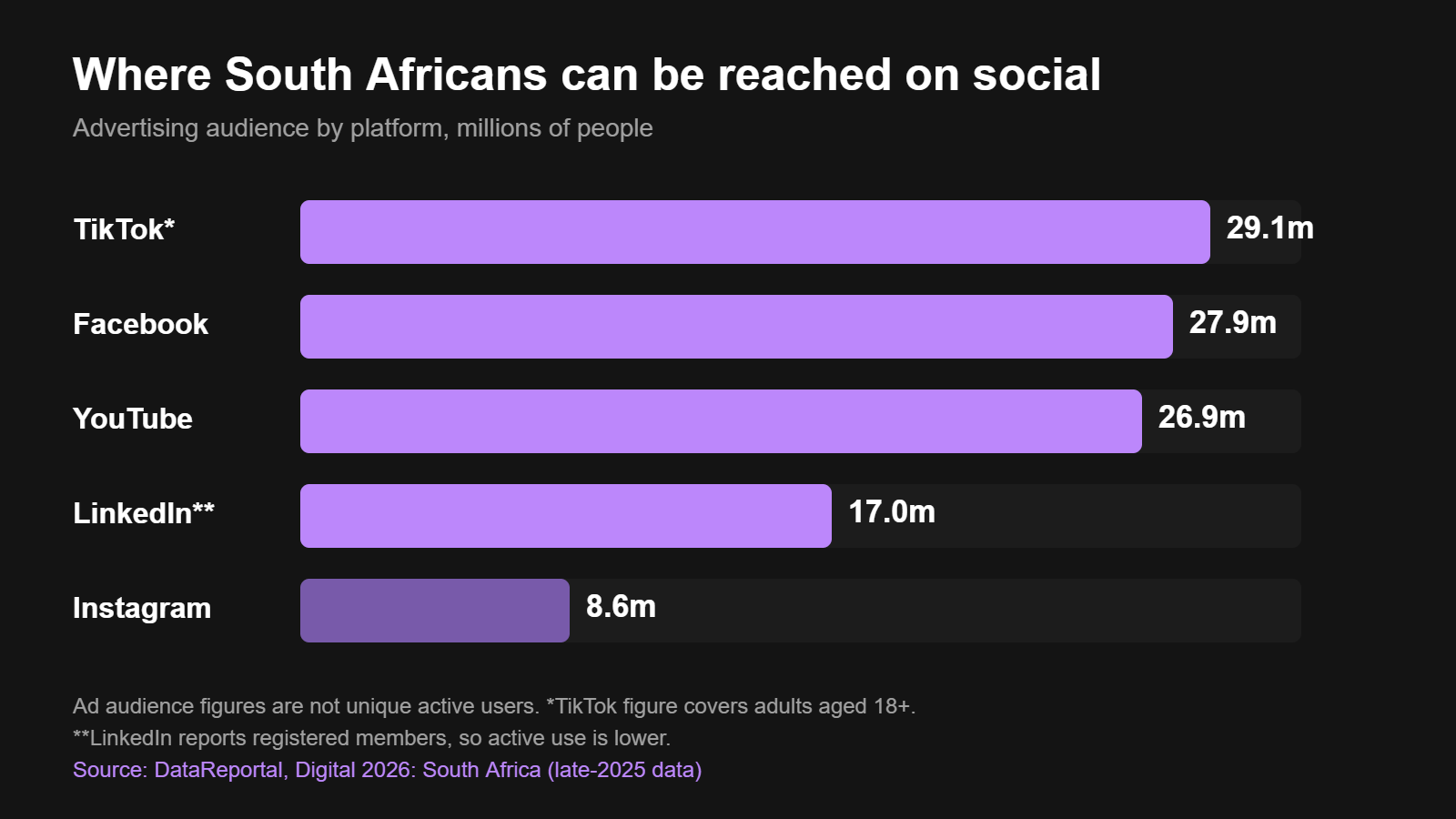
LinkedIn for reaching decision-makers by role and industry, and Facebook for broad local reach, including many owner-managed businesses. DataReportal puts LinkedIn’s South African audience at 17.0 million registered members and Facebook’s ad reach at 27.9 million people. Your own buyers decide the answer, so check where your best existing clients are active first.
How much does social media management cost in South Africa?
Agency retainers vary widely. At SynthX Media, managed plans run from R1,500 a month for one platform to R8,000 a month for three to four platforms.
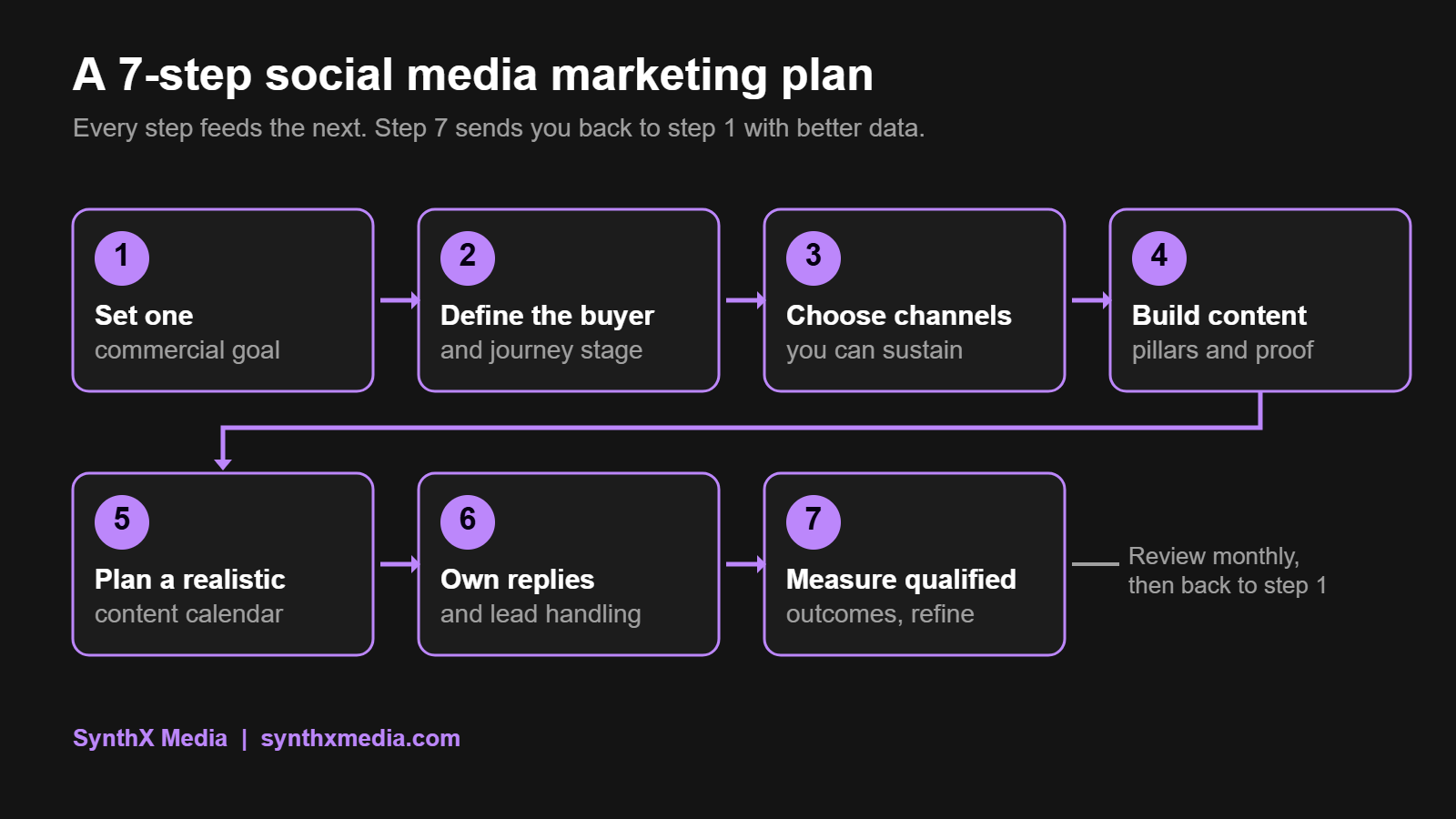
Step 1: Set one commercial goal for each campaign
Every social media marketing plan starts with one outcome and the exact action that proves it happened. “Grow our brand” cannot be measured. “Twenty quote requests for industrial coatings from Gauteng businesses this quarter” can.
Most commercial campaigns fit one of three goals:
- Enquiries: quote requests, call-backs, WhatsApp messages or site visit bookings.
- Consideration: visits to a service page, brochure downloads or case study views from the right audience.
- Retention: repeat orders, referrals or reviews from existing clients.
Running all three at once is possible, but give each its own campaign and its own measure. Otherwise the reporting turns into an average of three different things, which tells you nothing.
Step 2: Define the buyer and where they are in the decision
Describe the people you want to reach by role, problem, location and influence over the purchase. A procurement officer at a mine, a facilities manager at an office park and an owner of a small engineering works all buy differently, even when they buy the same service.
Then match content to the stage of the decision:
| Stage | What the buyer needs | Content that works |
|---|---|---|
| Discovery | To recognise the problem and that someone solves it | Short explainers, common mistakes, before-and-after photos |
| Evaluation | Evidence you can do the job, safely and on time | Case studies, process walk-throughs, compliance and accreditation detail |
| Enquiry | A clear, low-effort way to make contact | Posts with a direct call to action, lead forms, WhatsApp click-to-chat |
| Retention | Reasons to come back or refer | Maintenance reminders, new services, client shout-outs (with permission) |
B2B buying cycles are long and involve several people. If your content only ever speaks to the discovery stage, the technical buyer who arrives later finds nothing that answers their questions. Industries such as manufacturing and professional services need very different evidence at the evaluation stage, so plan for it specifically.
Step 3: Choose channels using South African audience data
The channels in your social media marketing plan should follow your buyers and your capacity, not a list of every platform available. Here is the current South African picture from DataReportal’s Digital 2026 report:
| Platform | SA ad audience | Best commercial use |
|---|---|---|
| 27.9 million | Local reach, owner-managed businesses, lead forms, community and service updates | |
| 17.0 million members | Targeting by job title, company and industry. Strongest for B2B credibility | |
| YouTube | 26.9 million | Demonstrations, process videos and how-to content that also gets found in search |
| TikTok | 29.1 million adults (18+) | Reach and recruitment. Works for B2B only with a team comfortable on camera |
| 8.6 million | Visual products, hospitality, retail and finished-project portfolios |
Two cautions. Ad audience figures are not the same as active daily users, and LinkedIn counts registered members, many of whom rarely log in. Use the numbers to compare platforms, not to forecast results.
Then be honest about capacity. One platform answered well beats four platforms answered occasionally. An unattended inbox with three unanswered quote requests does more damage than having no page at all.
Finally, look at two or three competitors. Note which questions they answer, which formats get a response and what nobody is covering. The gaps are your opportunity.
Step 4: Build content pillars around buyer questions and proof
Content pillars keep the calendar focused. For most commercial businesses, these four cover the ground:
- Answers: the questions your sales team hears every week, answered properly.
- Process: how you do the work, what a project looks like and what the client can expect.
- Proof: case studies, completed jobs, certifications and client feedback, with permission.
- People: the team, the site, the workshop. Buyers want to see who they will deal with.
Match format to message. A photo carousel suits a before-and-after job. A short video suits a process. A longer LinkedIn post suits a complex decision. For customer stories, explain the problem, what you did and the result. Praise without context does little for a buyer trying to judge whether you fit their situation.
Step 5: Build a social media content calendar your team can sustain
The calendar is where a social media marketing plan turns into weekly work. Plan a month at a time. Here is a simple four-week layout for a commercial business on one or two platforms, at roughly the volume of a typical starter plan:
| Week | Post 1 | Post 2 | Ongoing |
|---|---|---|---|
| 1 | Answer: top customer question | Proof: recent completed job | Reply to comments and messages every working day. Log every enquiry. |
| 2 | Process: how a project runs | People: meet the team | |
| 3 | Answer: cost or timing question | Proof: client story with results | |
| 4 | Offer: direct call to action | Review month and plan next |
Notice what is not in the calendar: daily posting for the sake of it. The right cadence is the one you can keep up while still answering people quickly. Adding posts before your response process works just creates more unanswered messages.

Step 6: Decide who replies, who escalates and who closes
This is the step a typical social media marketing plan skips, and it is where most of the lost revenue sits. Before anything goes live, agree the following:
| Situation | Owner | Target response |
|---|---|---|
| General comments and questions | Social media manager | Same working day |
| Quote requests and sales enquiries | Named salesperson | Within business hours, logged in your CRM |
| Complaints | Manager or client service lead | Acknowledge publicly, resolve privately |
| Technical, legal or safety questions | Specialist | Escalate, then reply with an accurate answer |
Set the targets that suit your business, write them down and check them monthly. Then record every social enquiry in your CRM, or at minimum a shared spreadsheet, with the source, the date and what happened next: quote sent, meeting booked, job won or reason lost.
On paid campaigns, keep it disciplined. Use organic posts to build familiarity, then put budget behind a specific message, a defined audience and one call to action. Test one variable at a time. We cover the budget split in more depth in paid social vs organic reach.
Step 7: Measure what your social media marketing plan produces
Report on outcomes first and activity second:
| Measure | Why it matters | Where to get it |
|---|---|---|
| Qualified enquiries | The closest signal to revenue | CRM, tagged by source and campaign |
| Work won and value | Proves return on the spend | CRM or invoicing records |
| Response time | Slow replies lose leads you already paid for | Meta Business Suite, LinkedIn page inbox |
| Website clicks | Shows whether posts drive action | UTM-tagged links in Google Analytics |
| Reach and engagement | Context for the numbers above | Native platform insights |
Ask your sales team how new clients first heard of you. Social often assists a sale that a Google search or a referral finally closes, and attribution software will not always see it. Review monthly, compare results with the original goal, and adjust audience, content, cadence or budget based on what moved enquiries. If enquiries stall, check every step from message to follow-up before spending more.
What a managed social media marketing plan costs in South Africa
If you would rather hand the work over, here is what our social media marketing plans include. Graphics and copywriting come with every plan.
| Plan | Monthly | What you get |
|---|---|---|
| Starter | R1,500 | 1 platform (Facebook or Instagram), 5 posts, engagement twice a week, page setup and a monthly report summary |
| Growth | R4,000 | Up to 2 platforms, 12 posts, weekday engagement, monthly report with actions |
| Premium | R8,000 | Up to 3 to 4 platforms, 20 posts, content pillar planning, daily weekday engagement |
For most commercial businesses, Growth is the sensible starting point because it includes weekday engagement, which is what turns posts into conversations. If social is one part of a wider lead generation push, our digital marketing retainers bring search, ads and social under one plan. For a broader view of what is working locally this year, see social media marketing in South Africa.
POPIA applies to your social leads too
Names, numbers and email addresses collected through lead forms or messages are personal information under POPIA. Collect only what you need, say what you will use it for, keep it secure, and get consent before adding someone to electronic direct marketing such as email newsletters or WhatsApp broadcasts. Every marketing message should offer a simple way to opt out. For specifics, check the Information Regulator or your legal adviser.

Frequently asked questions
How do I create a social media marketing plan for a small business?
Start with one goal you can measure, such as quote requests. Choose one platform your customers use, plan four weeks of content around their questions and your proof of work, and decide who answers messages. Review results monthly before adding channels or posts.
How often should a South African business post on social media?
As often as you can while still replying to every comment and message on the same working day. For most commercial businesses that means one to three quality posts a week per platform. Consistency and fast replies matter more than volume.
Should a B2B company in South Africa use TikTok?
Only if you have people comfortable on camera and a clear reason, such as recruitment or reaching younger owner-operators. For most B2B lead generation, LinkedIn and Facebook are the better starting points, with YouTube for demonstration content.
How do I measure whether my social media marketing plan is working?
Tag every social enquiry in your CRM by source and campaign, then track how many become quotes and won work. Use UTM-tagged links to see website visits from social. Reach and likes help explain the results, but they are not the results.
What does POPIA mean for social media leads?
Contact details collected through social media are personal information. Collect only what you need, explain how you will use it, keep it secure, and get consent before sending electronic direct marketing. Always give people an easy way to opt out.
Start with the follow-up, then post more
A social media marketing plan works when the goal is clear, the channels match your buyers and capacity, the content answers real questions, and every enquiry reaches someone who acts on it. Get those right on one platform, measure what comes in, and only then add volume or channels.
If you want a second opinion on your current setup, talk to our team and we will tell you where enquiries are getting lost and what we would change first.
Source for platform figures: DataReportal, Digital 2026: South Africa. Figures reflect late-2025 data and platform-reported advertising audiences.