 Skip to content


“Heavy haulage” gets about 10 searches a month in South Africa. “Abnormal load” and its related terms get roughly 500.
That single gap explains why so many South African carriers build service pages that nobody finds. The industry language used in boardrooms and on international trade sites is not the language buyers type into Google here.
Below is the actual South African search data for abnormal load transport, what it says about buyer intent, and how to structure service pages around terms that exist rather than terms that sound professional.
Key takeaways
| What we found | What to do about it |
|---|---|
| “Heavy haulage” barely registers here | About 10 searches a month. Use it in your company description if you like, but do not build a page strategy on it. |
| “Abnormal load” is the South African term | Roughly 500 monthly searches across the cluster, nearly all at low difficulty. This is the gap worth filling. |
| Permit questions dominate that cluster | Escort requirements, permit applications, fees and rules. Answer them and you meet buyers before the tender. |
| The commercial volume sits one level up | “Logistics company South Africa” and “transport company near me” carry the enquiries. Your service pages should target those. |
| Contract and one-off intent need different pages | A recurring capacity conversation and a single oversized move are different sales. One page cannot serve both well. |
| Measure enquiries, not visits | Traffic on informational permit terms is worth having, but only if you track which pages produce real work. |
Quick answers
What do South African freight buyers search for instead of “heavy haulage”?
“Abnormal load” and its variants. The core term draws around 170 searches a month locally, with escort vehicle requirements, permit applications, permit fees and rules adding several hundred more. “Heavy haulage” variants sit at roughly 10 a month each.
Which terms carry actual buying intent?
The broader commercial terms: “logistics company South Africa” at about 1,900 a month, “trucking company South Africa” at 880, and “transport company near me” at 480. Abnormal load terms are mostly informational, which makes them useful earlier in the buying process rather than at the point of enquiry.
Should a carrier build pages for every route?
No. Build a route page only when you can add real operational detail for that corridor: which permits apply, what escort arrangements are needed, and what the road actually allows. Near-duplicate pages with swapped place names help nobody.
The abnormal load transport data most carriers have never seen
Here is the South African search picture, pulled this month. The contrast is the point.
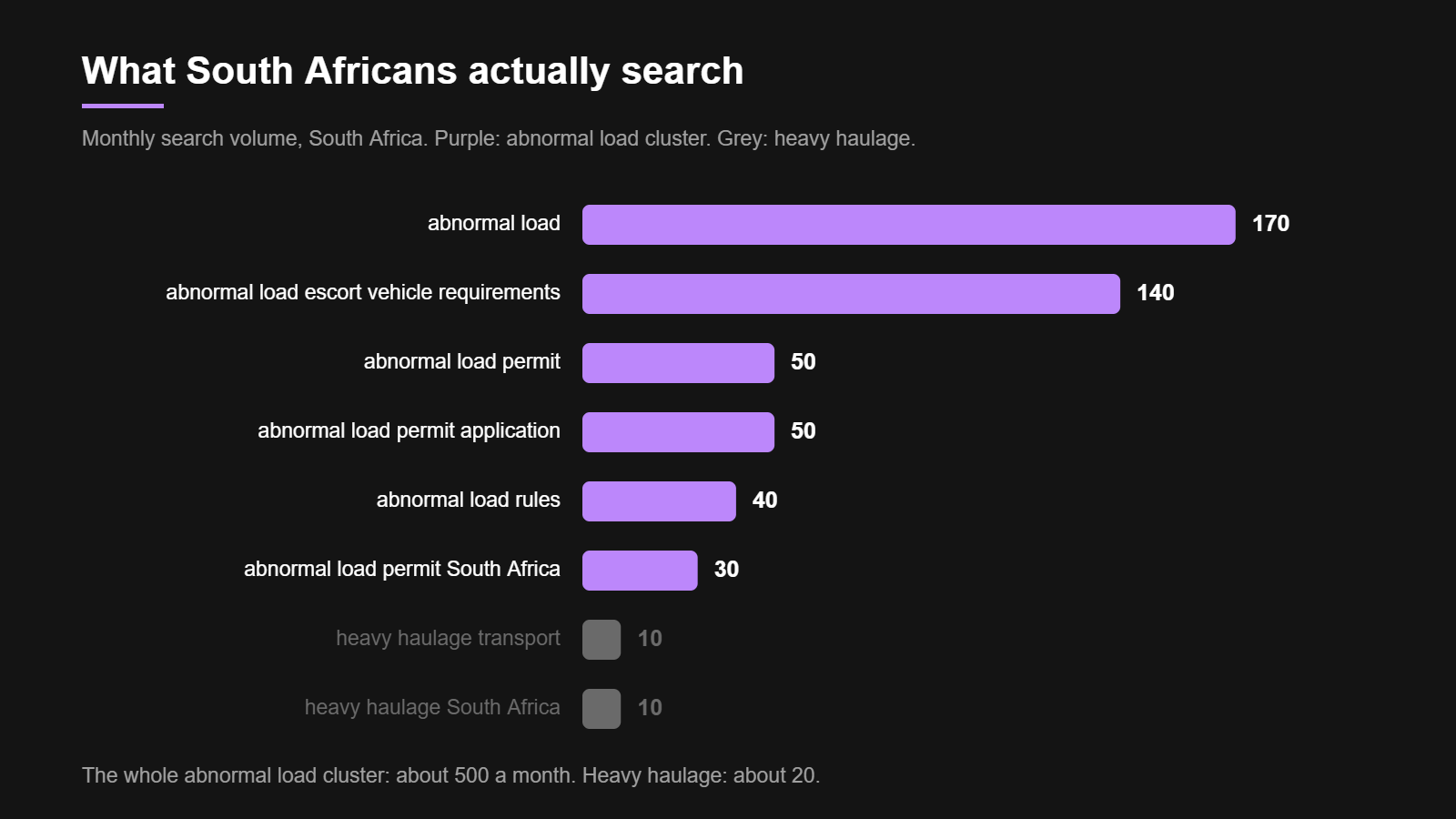
| Search term | Monthly searches (SA) | Difficulty |
|---|---|---|
| abnormal load | 170 | 20 |
| abnormal load escort vehicle requirements | 140 | 13 |
| abnormal load permit | 50 | 17 |
| abnormal load permit application | 50 | 7 |
| abnormal load rules | 40 | 13 |
| abnormal load permit South Africa | 30 | 7 |
| abnormal load permit fees | 30 | 7 |
| heavy haulage transport | 10 | 23 |
| heavy haulage South Africa | 10 | 15 |
A difficulty score in single digits on a term with 50 monthly searches is not glamorous. It is, however, winnable inside a quarter by a carrier who writes one honest page about how permit applications actually work.
Compare that with the effort required to rank for a term drawing ten searches a month, and the priority sorts itself out.
That statistic reframes the whole exercise. If most contracts go to vendors the buyer already knew about, then being found while somebody is researching escort requirements is not a consolation prize. It is how you get onto the shortlist months before a request for quotation appears.
Where the real commercial volume sits above abnormal load transport
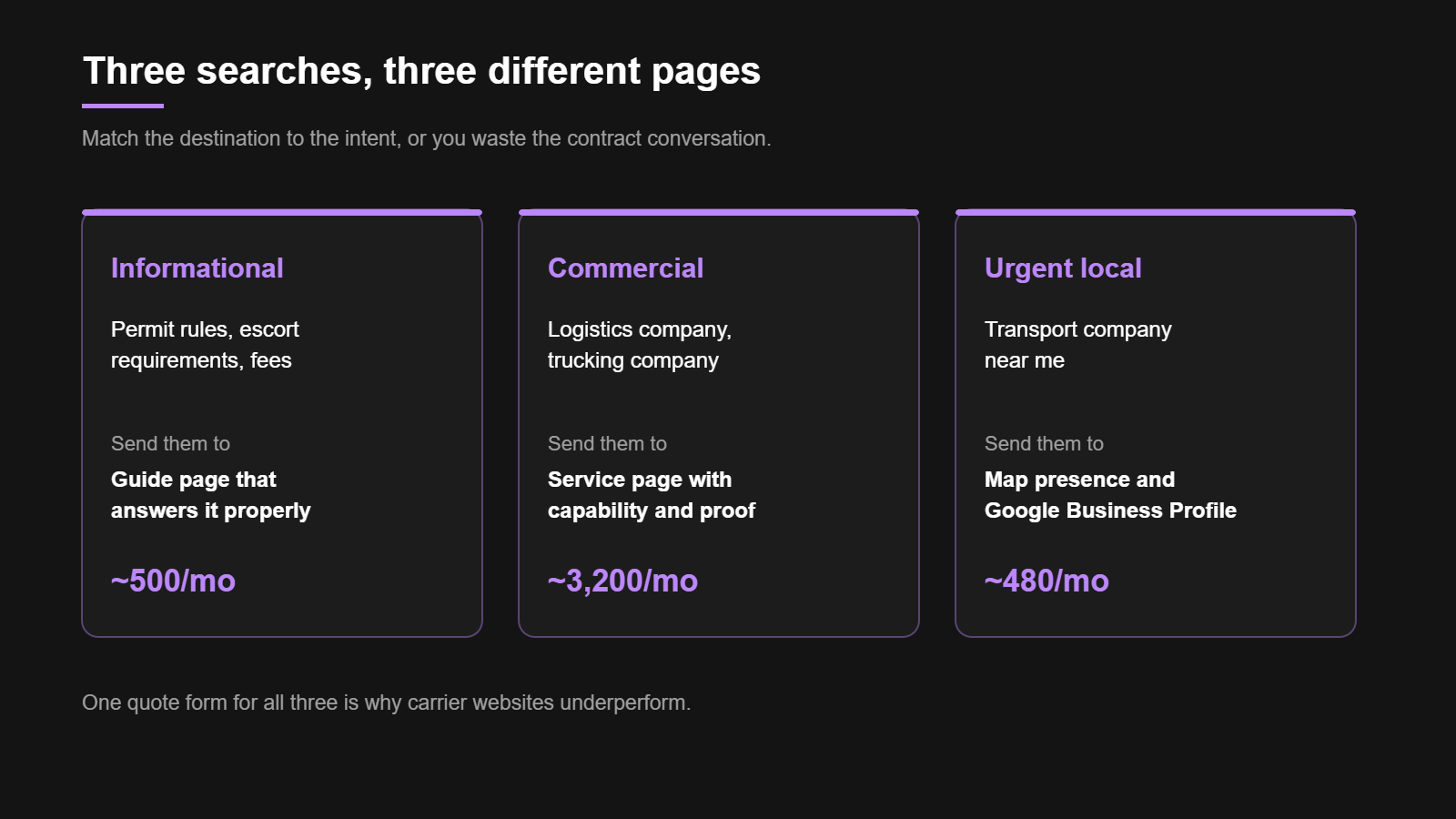
Abnormal load transport terms are mostly informational. People searching them are usually working something out, not appointing a carrier that afternoon. The transactional volume lives one level up.
| Term | Volume | Difficulty | Verdict |
|---|---|---|---|
| logistics company South Africa | 1,900 | 41 | The prize. Hard, and worth a dedicated service page. |
| trucking company South Africa | 880 | 23 | Strong volume at reachable difficulty. Best ratio on the list. |
| transport company near me | 480 | 18 | Map-pack territory. Your Google Business Profile matters more than any page. |
| transport company in Johannesburg | 480 | 32 | Worth a location page if Gauteng is a real operating base. |
| logistics and transport company | 390 | 32 | Useful supporting term. |
| transport company Gauteng | 210 | 39 | Regional variant, lower priority than the Johannesburg term. |
The structure this implies is straightforward. Informational abnormal load content brings researchers in early. Commercial service pages catch people ready to appoint. Location pages and your map presence catch the urgent ones.
If local enquiries are the priority, profile completeness and review activity carry more weight than any article. Our transport and logistics industry page sets out how we approach that for fleet and freight operators.
Separate contract intent from one-off moves
This part of the thinking holds regardless of terminology, and most carrier websites get it wrong.
In abnormal load transport, a shipper looking for recurring capacity and a shipper moving one transformer are different buyers with different timelines, different decision-makers and different objections. Pointing both at the same “get a quote” form wastes the contract conversation and slows the urgent one.
- Contract signals: dedicated capacity, recurring, contract carrier, ongoing. Send these to a page explaining service scope, capacity planning and how procurement discussions start.
- Project signals: quote, move, single load, specific equipment. Send these to a form asking for load dimensions, mass, route and timing.
- Ambiguous terms: a bare “abnormal load transport” search could be either. Qualify on the page rather than guessing, by offering both paths clearly.
The search phrase suggests intent. The enquiry confirms it. Ask for shipment frequency and expected volume early and you will separate the two before the first call.
Answer the abnormal load transport permit questions properly
The permit cluster is the most underserved opportunity in this whole data set, and it plays directly to a carrier’s expertise.
Abnormal load transport permits in South Africa are handled provincially, which means a cross-province move can involve more than one authority and more than one set of conditions. Escort requirements, travel time restrictions and route approvals vary with the load. That complexity is exactly why people search for answers.
A carrier who publishes a clear, current explanation of how the permit process works, what information is needed, and roughly how long it takes, becomes the obvious authority to phone when a real load appears. Two cautions worth respecting:
- Verify current requirements before publishing. Regulations and fee schedules change. Publishing stale permit detail damages the credibility this content is meant to build.
- Be clear about what you handle versus coordinate. If you apply for permits in some provinces and subcontract in others, say so. Buyers need to know where your responsibility begins and ends.
Build capability pages around equipment you actually operate
Combine an abnormal load transport term with the capability that makes the job possible: low-bed and extendable trailer work, multi-axle configurations, specific mass and dimension ranges. Use each only where it reflects your real fleet.
Three things belong on a capability page:
- Equipment. The trailer configurations you operate and the load types they carry.
- Load handling. Loading, securement and coordination methods your team provides directly.
- Compliance support. Route surveys, permit coordination, escorts and engineering liaison, mentioned only where you genuinely provide or arrange them.
Broadening a page with capabilities you cannot support creates qualification work for your own team and erodes trust when the gap surfaces. Keep separate pages for genuinely distinct buyer needs, not for every wording variation of the same service.
Corridors beat city pairs
South African freight moves along a relatively small number of major corridors. The N3 between Durban and Gauteng, the N1 running north and south, the N4 toward Maputo, and the routes serving the mining regions and the major ports.
Corridor pages work when they carry operational substance: which permits that route requires, what the road physically allows, where the constraints sit, and what information you need to assess a move along it. Build one only where you can write that detail from experience.
A national service area does not make every city pair a credible target. Five substantive corridor pages will outperform thirty thin ones, and they will not dilute each other competing for the same terms.
Give buyers the evidence they need
Commercial freight buyers are assessing risk as much as price. Make the evidence easy to find and easy to connect to the service in question:
- Applicable insurance cover and the limits that apply
- Safety record and operating credentials
- Comparable project experience, with confidential detail removed
- Clear service area boundaries and what happens outside them
A case study can explain the load challenge, the equipment used and how the move was coordinated without naming the client or exposing route detail they would rather keep private. Ask permission, then publish what you are allowed to.
Measure qualified enquiries, not visits
Informational abnormal load transport traffic is only worth having if you know what it produces. Track visits alongside calls and quote requests, and record whether each enquiry concerns recurring capacity, a single move, or work outside your capability.
Three questions to ask monthly:
- Are the enquiries for recurring work or one-off shipments?
- Do the requested equipment, methods and jurisdictions match what you operate?
- Which page and which term brought in the enquiries that turned into work?
Rising traffic with no relevant enquiries means the intent behind the term does not match the work you want. That is a signal to revisit the page, not to publish more of them. The technical side of making pages readable and measurable is covered on our technical SEO page, and the broader approach on our SEO services page.
Frequently asked questions
Why does “heavy haulage” perform so poorly in South African search?
It is industry vocabulary rather than buyer vocabulary here. South African shippers, permit authorities and operators use “abnormal load”, so that is what gets typed into Google. Heavy haulage variants draw roughly 10 searches a month locally, against several hundred across the abnormal load cluster.
What is the best abnormal load transport keyword to target first?
Start with the permit questions. “Abnormal load permit application” and “abnormal load permit South Africa” both sit at difficulty 7, which is close to uncontested, and they attract exactly the people who will need a carrier later. The escort vehicle requirements term carries the highest volume in that group at around 140 a month.
How many keywords should one service page target?
One clear buyer need per page. If two phrases describe the same service and lead to the same qualification conversation, explain them together on one substantive page rather than splitting them across two thin ones.
Should a smaller carrier target national search terms?
Only where it can credibly serve the routes implied and explain how it manages coverage. A focused national offer built around one defined capability reads as more credible than a claim to handle every abnormal load requirement in the country.
How long before organic search produces contract enquiries?
There is no fixed timetable. Low-difficulty permit terms can move within a quarter. Competitive commercial terms take considerably longer. Judge progress on qualified enquiries rather than treating an early rise in visits as commercial success.
What should a contract enquiry form ask for?
Expected shipment frequency, approximate start timing, load dimensions and mass, and the corridors under consideration. Those four fields separate a recurring capacity discussion from a single project before anyone picks up the phone.
Can route and corridor pages hurt a site?
Yes, when they are near-duplicates. Thirty pages with swapped place names and identical body copy compete with each other and signal thin content. Five pages carrying genuine operational detail for corridors you actually run will do more.
Start with the terms your buyers actually use
Most abnormal load transport websites are written in the language of the industry rather than the language of the buyer. The gap between 10 searches and 500 is the cost of that.
Request a free audit and we will show you which terms your site currently ranks for, which ones your buyers are actually searching in South Africa, and where the gap between the two is costing you enquiries.