 Skip to content


A Gauteng fleet does not break down at a convenient time. It breaks down on the N3 at 06:40 with a delivery window closing, and the person holding the phone has about ten minutes of patience before they scroll to the next supplier on the map.
That is the entire commercial case for local SEO for fleet services. Not brand awareness. Not traffic volume. The ability to be the supplier who gets called inside that ten-minute window, and the supplier who gets shortlisted when the same fleet manager reviews maintenance contracts three months later.
Here is how that works in practice, and where most Gauteng operators are leaking the calls they have already earned.
Key takeaways
| What you do | Why it matters for Gauteng fleets |
|---|---|
| Complete your Google Business Profile properly | It drives map visibility, calls, direction requests and enquiries. It is the storefront urgent buyers actually use. |
| Keep name, address and contact details identical everywhere | Inconsistency creates doubt at exactly the moment a fleet manager is comparing two suppliers under pressure. |
| Build location pages for the corridors you actually service | Isando, Germiston, Boksburg, Midrand and Rosslyn are how Gauteng buyers phrase it. Match their language. |
| Run reviews as a weekly system | The trust bar rose sharply in 2026. Volume, recency and owner replies now gate the enquiry. |
| Get findable inside AI answers | Buyers increasingly ask an assistant before they open Maps. If you are not cited, you are not on the list. |
| Audit before you rebuild anything | Map presence, listings and service areas first. Fix the leak before you spend on new pages. |
Quick answers
What is local SEO for fleet services?
It is your map presence, profile completeness, review habit and service-area pages, built so a nearby fleet buyer can find you and contact you inside a few minutes.
Why do Gauteng fleet buyers move so fast?
Because downtime compounds. A stationary vehicle becomes a missed delivery, a penalty clause and an unhappy client, so “near me” turns into an immediate call.
What is the biggest hidden leak?
Incomplete profiles, contact details that differ between your website and your listings, and a service area that does not match where you actually operate.
Where should you start?
Audit your profile, citations and service areas. Fix the gaps. Then build location pages and a review routine that keeps the profile active.
Gauteng fleet buyers have two modes, and both are local
Fleet procurement runs on two clocks.
Urgent: a breakdown, a recovery, a part that stops a load. The buyer opens Maps or asks an assistant, calls two or three suppliers, and books the one who answers with a straight timeline.
Planned: maintenance schedules, parts supply agreements, service contracts. Slower, more people involved, and shortlisted weeks before anyone picks up a phone.
Local visibility feeds both. Google is explicit that local results are shaped by three things: relevance, distance and prominence. You cannot bluff relevance. You earn it through how completely you describe your services and how precisely you describe the areas you cover. Distance is not a technicality when a fleet manager needs a vehicle moving before the next shift.
DID YOU KNOW?
BrightLocal, Local Consumer Review Survey 2026 (panel of 1,002 US adults, February 2026). US data, but the direction of travel holds in South African local search.
47% of consumers will not consider a business with fewer than 20 reviews, and 31% now only use businesses rated 4.5 stars or higher, nearly double the 17% recorded a year earlier.
Your Google Business Profile is the storefront, your website is the proof
Most fleet operators treat the homepage as the shopfront. In urgent local search it rarely is. The profile in the map pack is what the buyer sees, judges and taps.
Which means an “almost finished” profile is a competitor’s opportunity. Here is the completeness standard we work to on our SEO and local search engagements:
| Profile element | What “done” looks like for a fleet business |
|---|---|
| Primary and secondary categories | Chosen for the job the buyer needs, not the category that flatters your brochure |
| Services | Every service listed individually with a short description, including after-hours and callout work |
| Hours | Accurate, with public holidays loaded and after-hours contact stated in the description |
| Photos | Workshop, bays, branded vehicles, team, parts stock. Real photos, refreshed quarterly |
| Service areas | The suburbs and corridors you genuinely reach, not “Gauteng” as a single blanket entry |
| Contact consistency | Identical business name, address and phone number across your site, listings and directories |
| Q&A | Seeded with the five questions you answer on the phone every week |
For a fleet manager comparing suppliers, this is procurement friction reduction. They are not looking for personality. They are looking for a supplier who is verifiable, reachable and clearly local.

Match your online footprint to the corridors where vehicles actually stop
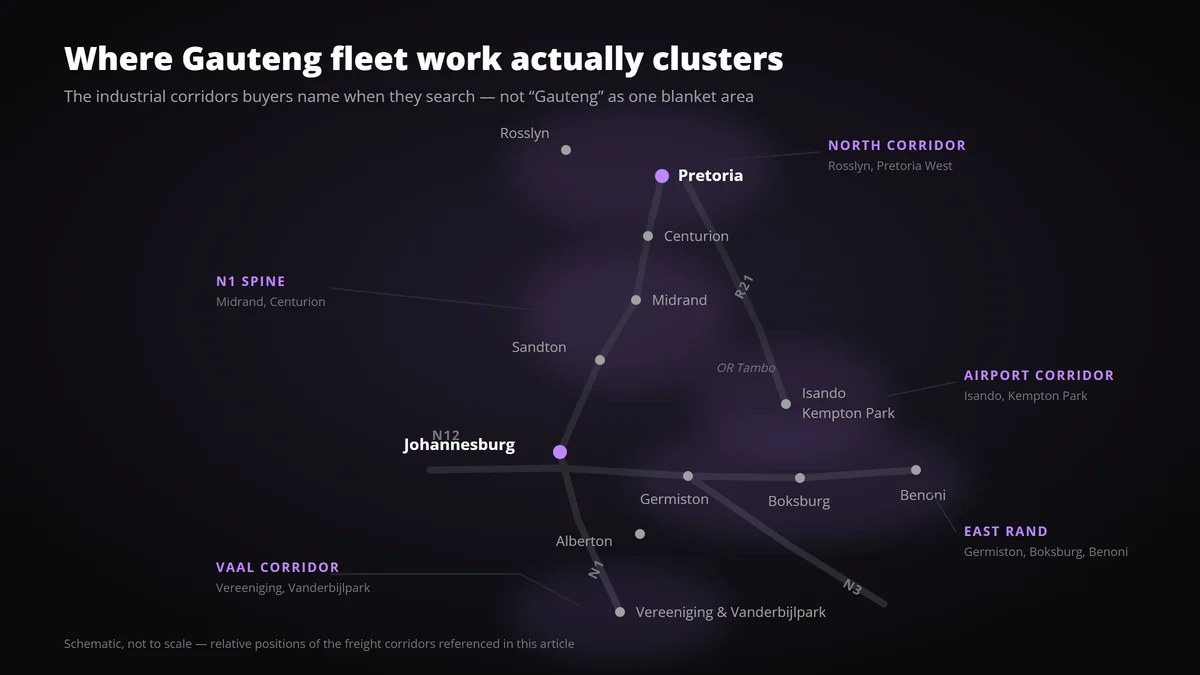
Fleet work is not spread evenly across the province. It clusters where the industrial parks and the freight routes are: Isando and Kempton Park around OR Tambo, Germiston and Alberton on the East Rand, Boksburg and Benoni along the N12, Midrand and Centurion up the N1, Rosslyn and Pretoria West in the north, and the Vaal corridor to the south.
Generic “we service Gauteng” copy forces a buyer to guess whether you reach them. In fleet services, a guess becomes a call to someone else.
The fix is structural. Build supporting pages for the areas that carry real revenue, each with local proof, specific suburb references and clear detail on how you operate there. Our Johannesburg service area page and Pretoria and Tshwane page show the structure we use: suburb-level targeting, credibility signals and a single obvious next step.
One warning. Location pages only work when they carry distinct, useful content. Twelve near-identical pages with the suburb name swapped out is a liability, not a strategy.
Reviews stopped being brand fluff, and the bar moved in 2026
Reliability is the product in fleet services, and reviews are the only public evidence of it. The 2026 consumer data makes the shift hard to argue with.
Review reading intensified: 41% of consumers now always read reviews when browsing for a business, up from 29% the previous year. Response speed became a live expectation, with 19% expecting a reply to their review the same day, up from 6%, and a further 32% expecting one by the next day.
So treat reviews as an operational routine, not a hopeful accident:
- Cadence. One or two new reviews a week beats a burst of fifteen and then silence for a year.
- Specificity. Ask in a way that prompts detail on turnaround, workmanship and communication, because those are the three things fleet buyers actually worry about.
- Recency. A profile whose newest review is from 2024 reads as a business that has gone quiet.
- Owner replies. Reply to everything inside 24 hours. It signals accountability to the next prospect reading the listing.
- Trigger points. Tie the request to the service moment the client remembers: vehicle released, job signed off, part delivered.
DID YOU KNOW?
BrightLocal, Local Consumer Review Survey 2026.
85% of consumers say they are more likely to use a business after reading positive reviews, and 77% are put off by negative ones.

Local search now includes AI answers, and most fleet suppliers are invisible there
This is the change most local guides published this year still ignore. Buyers are increasingly asking an assistant for a shortlist before they ever open Maps.
BrightLocal’s 2026 survey recorded AI tool usage for local business recommendations jumping from 6% to 45% in a single year, while Google’s share of review platform usage fell from 83% to 71%. Fragmentation, not replacement, but the practical implication is direct: if an assistant cannot confidently state what you do and where you do it, you do not make the shortlist it hands over.
What actually moves this:
- Structured data on your service and location pages so machines can read your offering without guessing
- Plain, unambiguous statements of capability, service area and contact method in the page copy itself
- Consistent citations across directories, industry listings and your own site
- Content that answers the specific question a buyer asks, in the words they ask it
This is the work we cover under SEO and answer engine optimisation, and it compounds with your map presence rather than competing with it.
Visibility opens the conversation, capability proof wins the job
Getting found is the cheap half. Fleet buyers disqualify suppliers quickly, and usually for the same four reasons.
| Buyer question | What your site must answer within one screen |
|---|---|
| Can you handle our fleet type? | Vehicle classes, brands and equipment you work on, stated plainly |
| Do you actually cover us? | Named suburbs and corridors, plus realistic callout radius |
| Do you have the part? | A catalogue searchable by OEM or part number, with stock or lead-time indication |
| How do we transact? | PO and account process, credit terms, VAT details, after-hours contact |
If you sell parts alongside service, searchability by part number is the single highest-leverage fix on the list. Every back-and-forth email you remove from the procurement process shortens the path from enquiry to order.
What that looks like in practice is set out on our transport and logistics page, which covers what fleet, freight and parts businesses usually need from a site.

What happens after the click
Map visibility is easy to sell and easy to measure badly. Fleet owners do not bank impressions. They bank job requests.
So when you evaluate local SEO services, ask one blunt question: what happens after the buyer contacts us? A serious answer covers speed, capture and follow-up.
| Metric | What it tells you | Review cadence |
|---|---|---|
| Profile calls and direction requests | Whether local intent is reaching you at all | Weekly |
| Missed and unanswered calls | The most expensive leak in fleet services, and the easiest to fix | Weekly |
| Form and WhatsApp enquiries | Whether your site converts the visit into a conversation | Weekly |
| Enquiry to quote rate | Whether you are attracting the right fleets or the wrong ones | Monthly |
| Quote to job rate, and job value | The only numbers that prove commercial return | Monthly |
Site speed and uptime belong in this conversation too. A buyer in a hurry does not wait for a slow page, which is why we keep website build and hosting in the same scope as the search work. Not sure where your current site is leaking? Start with our Website Speed Cost Calculator.
How to choose a local SEO partner for fleet growth in 2026
The “near me” agency noise is loud. Use this checklist instead of promises:
- They audit before they build. Profile, citations, service areas and current enquiry volume, measured first.
- They fix completeness before they add pages. Services, hours, photos and consistent contact details are the foundation, not an upsell.
- They build location pages with distinct content. Suburb-level targeting that reflects where your vehicles actually go.
- They run a review routine with you. Request triggers, reply cadence and reporting, not a one-off request blast.
- They handle structured data and AI visibility. Schema on service and location pages, so machines can read what you do.
- They understand fleet buying behaviour. Capability proof, part-number search and a friction-free path to a quote.
- They report on enquiries and jobs. If the monthly report stops at rankings and impressions, you cannot make a budget decision from it.
If you want to see how we scope and price this work, our SEO services page sets out what is included, and our digital marketing services cover the paid side when you need calls sooner than organic can deliver.
The commercial bottom line
Local SEO for fleet services comes down to one job: turning urgent intent into immediate contact, then turning that contact into a repeat maintenance relationship.
A complete Google Business Profile, consistent business details, real location pages for the corridors you serve, a weekly review habit and structured data that AI assistants can read. Combine those with capability proof and an enquiry path that does not leak, and local search stops being a visibility exercise. It becomes a measurable pipeline channel with a cost per job you can actually manage.
Frequently asked questions
What is local SEO for fleet services, and what should we fix first?
It covers your Google Business Profile, citation consistency, review habit and service-area pages. Fix profile completeness and contact consistency first. They cost the least, move the fastest and stop the biggest leak.
How long before we see results from local SEO?
Profile actions like calls and direction requests usually shift within four to eight weeks of fixing completeness and starting a review routine. Location page rankings and contract-level enquiries build over three to six months. Anyone promising page one in a fortnight is selling you something else.
Do we really need separate pages for Johannesburg and Pretoria?
If you service both, yes. A buyer in Rosslyn needs to see that you operate in Rosslyn, and a fleet manager comparing suppliers under time pressure will pick the one whose coverage is unambiguous. The pages have to carry genuinely different content though.
How do we measure whether local SEO is working?
Track profile calls, direction requests and website visits weekly, then connect them to enquiries, quotes and won jobs monthly. Contact behaviour improves before pipeline does, so watch the leading indicators first.
Does local SEO still matter if buyers are using AI assistants?
It matters more. Assistants build their recommendations from the same underlying signals: consistent business information, reviews, structured data and clear service descriptions. Strong local SEO foundations are what make you citable in an AI answer.
How many reviews do we need?
Enough that your rating reads as credible, which 2026 consumer research puts at above twenty for most buyers. Then keep them coming. Recency and owner replies now carry nearly as much weight as the average score.
Is a generic “SEO service near me” enough for a fleet business?
Usually not. Fleet search behaviour combines urgent local intent with B2B procurement scrutiny, so you need map presence, capability proof and part-level searchability handled together. Generic packages tend to cover the first and ignore the rest.
What does this cost?
It depends on how many service areas you cover, whether you sell parts, and the state of your current site. Our SEO services page sets out the packages, and a short audit tells us which one you actually need.
Get the leak report before you spend
We start every local engagement the same way: a review of your map presence, listings and service areas against how Gauteng fleet buyers actually search. You get a plain-language list of what is broken, what it is costing you and what to fix first.
Book a 20-minute local visibility review and we will tell you straight whether local SEO is your fastest route to more job requests, or whether something else on your site is the bigger problem.
