 Skip to content


If you want to know how to get mentioned in AI search, this is your precision playbook. Top-ranking pages see a 58% lower average click-through rate when an AI Overview is present, according to Ahrefs’ study of 300,000 keywords, which means the brands that win are not the ones sitting at position one; they are the ones inside the AI answer itself.

Key Takeaways
| Question | Answer |
|---|---|
| What does it mean to be mentioned in AI search? | It means your brand, content, or website is cited directly inside an AI-generated response, putting you in front of the user before they click anywhere. |
| What is the fastest way to get mentioned in AI search? | Build answer-first content, earn third-party citations in authoritative publications, and structure your pages so AI models can extract data cleanly. |
| Does brand authority affect AI citations? | Yes. Research suggests brand search volume correlates with AI citations more strongly than traditional link-building metrics. |
| How important is content formatting for AI mentions? | Critical. Structured formatting (headings, bullet points, tables) is easier for LLMs to pull into responses than unstructured prose. |
| Can our AI search optimization service help? | Absolutely. We build the full technical and content infrastructure needed to position your brand inside AI-generated answers, not just alongside them. |
| How long does it take to see results? | Most brands see measurable movement in AI citation frequency within 60 to 90 days when all 7 strategies are applied consistently. |
| Is this strategy only for large brands? | No. Niche authority and precise content formatting give smaller brands a legitimate path to AI mentions that outcompetes generic big-brand content. |
Why Getting Mentioned in AI Search Is the New Competitive Battleground
The rules changed. In 2026, AI Overviews appear on a large share of US Google searches (estimates range from roughly a quarter to nearly half, depending on the dataset), and the share keeps climbing.
One caveat for South African readers: most of the research quoted in this guide comes from US datasets, so treat the percentages as directional for local searches. The mechanisms are the same here: front-loaded answers, clear structure, and mentions on third-party sites that AI engines already trust, such as local industry directories and news publications.
Brands that operate with a traditional content mindset are bleeding visibility fast. The brands that understand how to get mentioned in AI search are owning the conversation before the click ever happens.
This is not a future problem. It is a right-now problem, and the 7 core strategies below are your solution.

Strategy 1: Build an Answer-First Content Framework to Get Mentioned in AI Search
AI models are answer machines. They pull from content that delivers a direct, clear answer at the very top of the page, not buried 800 words in.
The data confirms this: in an analysis of 1.2 million ChatGPT answers, 44.2% of citations came from the first 30% of a page’s content. That means your most important insights, definitions, and data points need to be front-loaded, every single time.
Here is how to execute an answer-first framework:
- Open every article or page with a direct answer to the primary question the content addresses.
- Use a concise summary paragraph (2-3 sentences max) before any background context.
- Place your most valuable statistic or insight in the first visible scroll window.
- Structure H2 headings as questions or direct statements, not clever titles.
- Avoid long intros, disclaimers, or “about this guide” filler sections at the top.
This is not about dumbing down your content. It is about making it impossible for AI to overlook you.
Strategy 2: Structure Your Content So AI Can Actually Extract It
Unstructured walls of text are invisible to AI models. If a language model cannot cleanly parse your content, it will not cite you. Full stop.
Structured formatting, meaning headings, bullet points, numbered lists, and tables, makes content easier for LLMs to extract and cite than unformatted prose. This is not a minor edge, it is a core mechanism.
Apply these formatting rules to every page that you want AI to consider:
- Use H2 and H3 headings that mirror the exact language of conversational questions.
- Break complex processes into numbered steps rather than prose explanations.
- Use comparison tables for any data that involves more than two variables.
- Add a clear summary or “key points” section near the top of long-form content.
- Mark up your pages with structured data (FAQ schema, HowTo schema, Article schema).
Your website’s technical foundation plays a direct role here. Pages that are clean, fast, and semantically structured give AI crawlers exactly what they need to pull your content with confidence.

Strategy 3: Use Digital PR to Earn Third-Party Citations That AI Trusts
AI models do not just pull from your own website. They validate brands through the wider web, and a large share of AI citations come from news sites, industry publications, and third-party media coverage.
This means your off-site presence is as important as your on-site content when it comes to getting mentioned in AI search results consistently.
Your Digital PR strategy should include:
- Press releases and media pitches to industry publications that AI models trust and regularly scrape.
- Expert commentary placements in relevant news articles, where your name and brand appear in an authoritative context.
- Podcast and interview appearances that generate transcript pages and citation-rich show notes.
- Co-authored articles on platforms with strong domain authority in your niche.
- Awards and recognition submissions to credible industry directories and rankings.
The goal is to build a web of third-party references that AI models can cross-reference when deciding whether your brand is worth citing.
Strategy 4: How to Get Mentioned in AI Search by Building Verifiable Brand Authority
AI models are not neutral. They have preferences, and those preferences are shaped by brand recognition signals they can verify across the web.
Research suggests brand search volume correlates with AI citations more strongly than traditional backlinks. If people are searching for your brand by name, that is a trust signal AI models appear to pick up on.
Build verifiable brand authority through these actions:
- Maintain consistent brand identity across every digital touchpoint. Your visual brand and messaging must be unified and instantly recognizable.
- Create campaigns that intentionally drive branded search volume, not just general traffic.
- Claim and fully optimize every business profile, including Google Business, LinkedIn, and industry directories.
- Get your brand featured in “best of” and “top tools” roundup articles in your niche.
- Build a Wikipedia or Wikidata presence if your brand qualifies for notability.
Authority is not an accident. It is a system, and you need to engineer it deliberately.
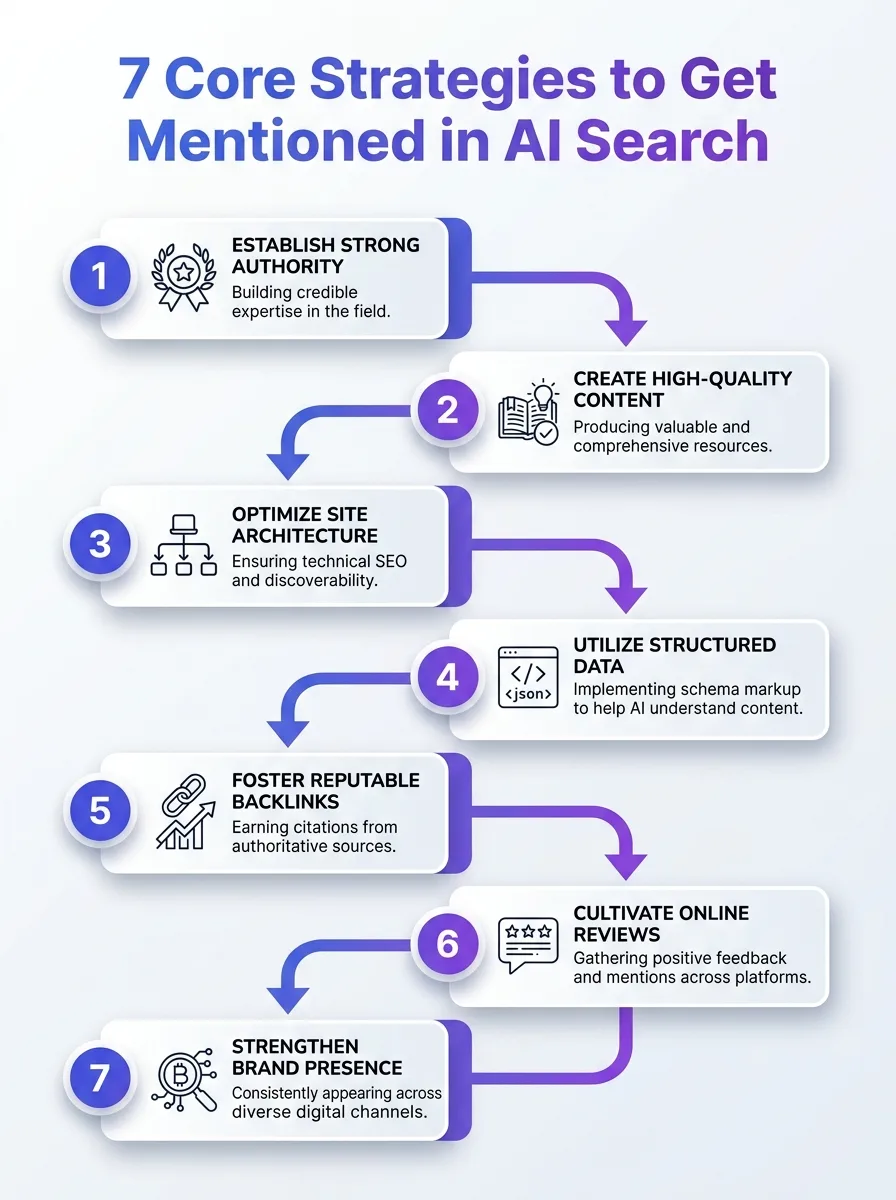
This infographic visualizes seven core strategies to get mentioned in AI search. Apply these steps to boost visibility in AI-driven search results.
Strategy 5: Optimize for the Conversational Queries AI Search Users Actually Ask
Here is a number that changes everything: AI search queries average 23 words in length, compared to just 4 words for a traditional web search.
People are not typing “best marketing agency.” They are asking “what is the best digital marketing agency for a B2B software company with a limited budget in 2026?” Your content needs to be built around these long, specific, situational questions.
How to optimize for conversational AI queries:
- Build dedicated FAQ sections on your key pages that answer highly specific, scenario-based questions.
- Create content clusters around a single topic, covering every angle an AI might need to answer a complex question fully.
- Use natural language throughout, writing the way your audience actually talks, not the way a document sounds.
- Address objections, comparisons, and edge cases inside your content, because AI pulls from nuanced coverage.
- Update your content regularly to maintain factual accuracy, since AI models weight recency for evolving topics.
Your digital marketing strategy needs to account for this shift in query behaviour at every level of your content production.

Strategy 6: Use Fact-Dense Content to Signal Credibility to AI Models
Generic marketing copy does not get cited. Data-backed content does.
In the Princeton GEO study, adding statistics and citing sources boosted visibility in generative answers by up to 40%, and expert quotations helped as well. AI models are looking for sources they can verify, and facts with attribution give them exactly that.
Make your content fact-dense using these tactics:
- Cite industry research and credible studies with direct attribution and links to the source.
- Include proprietary data from your own audits, client results, or internal research where possible.
- Quote recognized experts in your industry, with their names, titles, and organizations clearly stated.
- Use precise numbers rather than vague claims (“37% increase” beats “significant improvement” every time).
- Add “last updated” dates to your content so AI models can assess recency and reliability.
This is precision content strategy. If your content reads like a press release, AI will ignore it. If it reads like a research report, AI will cite it.
How to Get Mentioned in AI Search Through Consistent Cross-Channel Brand Signals
AI models build a composite picture of your brand from dozens of sources. If those signals are inconsistent, contradictory, or sparse, your citation potential drops sharply.
Consistency is not just about aesthetics. It is about giving AI enough coherent, cross-referenced data points to confidently describe and recommend your brand.
Your cross-channel consistency checklist:
- Your business name, description, and core offerings must be identical across your website, social profiles, directories, and press coverage.
- Publish content on a predictable schedule so AI models consistently encounter fresh material from your brand.
- Ensure your social media presence reinforces your positioning, because AI models scrape platforms like LinkedIn for brand signals.
- Build topical authority by consistently publishing in the same subject areas rather than spreading content too thin.
- Use your social media marketing as an amplification layer for your core content, not a separate channel.

How to Measure Whether Your AI Search Mention Strategy Is Working
You cannot manage what you do not measure. Tracking AI citation performance requires a different set of metrics than traditional web analytics.
Here is what to monitor on a weekly and monthly basis:
| Metric | What It Tells You | Tool to Use |
|---|---|---|
| AI referral traffic | Volume of visitors arriving from AI platforms (Perplexity, ChatGPT, Gemini) | GA4, UTM tracking |
| Brand mention frequency | How often your brand appears in AI-generated responses for target queries | Manual prompt testing, GEO tools |
| Branded search volume | Month-over-month growth in people searching for your brand by name | Google Search Console |
| Third-party citation count | Number of authoritative external sources mentioning your brand | Ahrefs, Moz, media monitoring tools |
| Time on site from AI traffic | Quality of AI-referred visitors | GA4 engagement metrics |
Pair your measurement with conversion optimization work to ensure the high-intent traffic that AI delivers is actually turning into leads and revenue.
Common Mistakes Brands Make When Trying to Get Mentioned in AI Search
Most brands approach AI citation the wrong way. They optimize their content for the old rules and wonder why nothing changes.
Here are the mistakes we see most often, and how to fix them fast:
- Writing for humans but not for machines. Great writing that is unstructured will not get cited. Format is not optional, it is functional.
- Focusing entirely on their own website. If the broader web does not know you exist, AI will not mention you either. Third-party validation is non-negotiable.
- Using vague, generic language. “We are a leading provider of solutions” tells AI nothing. Specific, niche-targeted language drives citation relevance.
- Ignoring branded search development. Brands that do not actively drive people to search for them by name are handing their AI citation potential to competitors.
- Publishing and disappearing. AI models reward fresh, regularly updated content. A blog post from two years ago will not hold its citation position if competitors are publishing new data consistently.
- Skipping schema markup. Structured data tells AI exactly what your content is about. Brands that skip this step are making AI work harder for no reason.
- Treating AI optimization as a one-time project. This is an ongoing strategy, not a campaign. Brands that build AI citation as a permanent operational discipline win in the long term.
Our GEO and digital marketing solutions are built specifically to address every one of these gaps with a systematic, precision-driven approach.

The Full 7 Core Strategies: A Quick-Reference Summary
If you want to get mentioned in AI search results consistently in 2026, here is the complete framework at a glance:
- Answer-First Content Framework: Front-load your most valuable answers so AI finds them immediately in the first 30% of your content.
- Structured Formatting for AI Extraction: Use headings, lists, tables, and schema to make your content machine-readable and citation-ready.
- Digital PR and Third-Party Citations: Earn mentions in authoritative external publications so AI can cross-reference your brand credibility.
- Verifiable Brand Authority Building: Drive branded search volume and consistent off-site signals that AI models use as a primary trust indicator.
- Conversational Query Optimization: Build content around long, specific, situation-based questions that match how real people prompt AI tools.
- Fact-Dense, Data-Backed Content: Load every key page with verifiable statistics, expert quotes, and precise claims that AI models can confidently surface.
- Cross-Channel Brand Signal Consistency: Ensure your brand identity, messaging, and topical authority are uniform across every digital touchpoint AI might crawl.
“AI visibility is not a coincidence. It is a system. Build the system, and the citations follow.”
Conclusion: Get Mentioned in AI Search or Get Left Behind
The brands that understand how to get mentioned in AI search and execute these 7 core strategies with precision are not just maintaining visibility, they are capturing it at scale while competitors struggle to figure out why their traffic is collapsing.
This is not a trend to watch. It is a shift that is already defining winners and losers in every industry in 2026.
No fluff. No filler. Just 7 proven strategies that put your brand inside the AI answer, where the attention is, where the trust is, and where the growth is.
Ready to move from invisible to cited? Our AI search optimization service is built to get your brand positioned exactly where it needs to be. Let’s build your system.